
DRAFT for Board Review: In the Path of Disaster: Minnie’s Island and the Sewer Line Break of 2026
Updated: 16 hours ago

Story by MICC Board Members Carolyn Finney and Joe Saliunas
Bad omens
Flashlights at midnight: our first tip-off that something had gone terribly wrong.
Late night January 19th, Minnie's Island Community Conservancy (MICC) Board Member Dallas Harrison glanced outside his window and observed utility flashlights probing the shadows of the canal directly below his home near Lock 10 of the C&O Canal.
The next tip-off came at dawn on the 20th. Morning commuters slowed to a crawl along the Clara Barton Parkway to observe the spectacle of thousands of seagulls wheeling and diving in a feeding frenzy over the Potomac. Later that day, MICC Board Member Neil Shaut spotted a raft of dead fish floating near the Minnie’s Island canoe landing. Hiking the shoreline, Tim Bragan and his son watched as the river turned from clear to murky before their eyes.
But by midday it was the smell – foul, penetrating, and pervasive – that revealed to the rest of the DMV what the midnight utility workers of DC Water and the gulls feasting on a massive fishkill had already figured out.

Fish kill at Minnies canoe landing by C&O canal, January 20
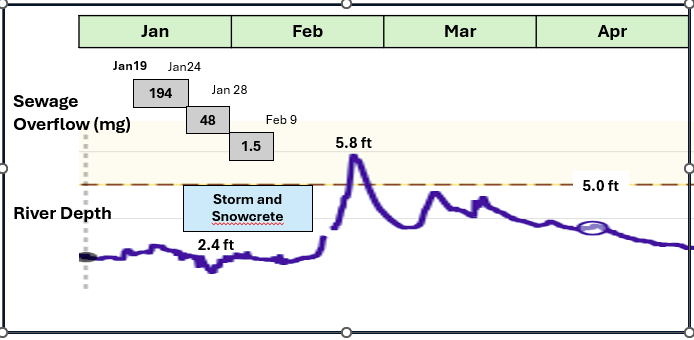
A six foot section of collapsed sewer line known as the Potomac Interceptor had erupted between Locks 10 and 11, spewing a torrent of raw sewage directly into the river at the rate of sixty million gallons per day and transforming the Potomac into a viscous waterway of human and non-biodegradable waste.
1400 yards downstream from the collapse, Minnie’s Island lay in the direct path of the spill’s onslaught.

Image from EU’s Sentinel-2 satellite on January 22 showing Minnies engulfed in sewage flow
A torrent of sewage
The next day, local residents and MICC members braved the smell to investigate the spill site on foot and by bike. Normally the area between Locks 10 and 11 is one of the most placid and unremarkable along that stretch of the canal. It was stunning to suddenly come upon a geyser of sewage spewing from the ground and racing in a torrent down into a culvert and directly into the river below.
As we looked on, the sleepy Lot 10 parking was mobilizing into a disaster remediation site with specialized waste treatment trucks from DC Water and county and state DEPs. Workers in hard hats were throwing up chain link fencing to seal off the spill area and mowing down the tall switchgrass in the canal bed to prepare for clay and plastic liners that would soon turn the canal into an open-air sewage reservoir.
A half mile down-river, several of us gathered under the sycamore at Minnie’s canoe launch. Days earlier we had stood in that same spot and admired the river’s brisk flow and the sparkling riverbed: every leaf, branch, rock, and minnow visible in perfect detail.
Now the river stood stagnant around the sycamore roots, dark and dense as coffee grounds. A dull oily film floated on the surface inches away from where MICC canoes, paddles, and life jackets lay stored.
Then hell froze over
The sewer line rupture occurred in a perfect storm of severe climate conditions. At the time of the spill, the Potomac was undergoing its third year of drought, bringing the river level to a near all-time low. The drought had left Minnie’s fragile shoreline, tree roots, and landing areas severely exposed to the force of the spill.
To make a dire situation worse, a severe two-day winter storm set in January 24-26 and blanketed the remediation site with an impenetrable layer of ice or “snowcrete.” Two weeks of single-digit temperatures followed, greatly hampering the effort of DC Water workers to cap the spill and forcing them to work around the clock in brutal conditions. While the ice blanket temporarily offset the odor, sewage was visibly frozen into the ice, an undeniable reminder of the contamination that lay below the surface.
Yet throughout the cold snap, residents near Lock 10 who were most directly affected by the spill – the inescapable stench, round-the-clock noise, heavy machine exhaust, portable light towers blazing into their windows throughout the night – showed up daily with hot coffee and snacks for the workers.
The cold snap eased by mid-February only to be followed by an ill-timed rainfall that created a high-water event on February 22 that overflowed the landing area on Minnie’s Island and flooded the island pools with sewage-laden water. The river subsequently reverted to historic low levels which prevented scouring of contaminated sediment from around the island.
Shock and anger. Then activism.
Looking back at those first 24 hours as we absorbed the magnitude of the spill, there was initially a sense of powerlessness. That powerlessness was swiftly replaced by anger and a determination to seek answers.
Could the break have been prevented? When would it be capped? When would water testing occur? At what sites, and how often? Was Minnie’s irreparably poisoned?
Within days, the spill transformed our members from paddlers, weed warriors, and builders into advocates and collaborators. Cabin reconstruction and all programming were halted as we pivoted into educating ourselves and our supporters about the magnitude of the spill and the dangers posed by E. coli, MRSA, staph, and other contaminants. MICC members Joe Saliunas and Carolyn Finney were interviewed by the Washington Post to share the impact of the spill and the island’s closing on MICC programming.
It took DC Water ten days to launch water testing at sites below the pipeline break, and based on the results, the MoCo Department of Health issued an advisory closing the river below the spill site on January 29. By February 9, over 243 million gallons of raw sewage had been released into the Potomac River directly upstream from Minnie's Island - considered one of the largest sewage spills in US history.
After frequent prodding by MICC, DC Water finally started water testing on Minnie’s launch area on February 18. The initial four days of testing showed the water exceeded the EPA standard of 410 cfu/100mL, and it is highly likely that levels exceeded the EPA standard since the start of the spill on January 19.
By mid-March, E. Coli levels from water testing returned to normal levels, and MoCo issued an updated advisory opening much of the river to recreational use. But the hardest hit stretch from the spill site to Lock 8 and Minnie’s remained closed.

Water testing at Minnies did not start until February 18 - one month after the start of the spill
MICC Advocacy and becoming CLEAR
The testing delay and other factors – the lack of posting closed areas, inaccurate and incomplete communications – made it painfully clear that DC Water had no comprehensive emergency plan in place, a shocking reality given the risks of an aging sewer system next to a fragile ecosystem. MICC members, however, knew from Day One that immediate action was essential. Below is a timeline summarizing Minnie’s advocacy and outreach from the spill in January through July when the sediment advisory was lifted.

Closure, testing and MICC advocacy milestones through July 2026
Alerted by reports from the Potomac Riverkeepers Network, MICC board members monitored the spill site near Lock 10 almost every day for the first two weeks. The Board’s first action was to send a letter (Appendix A) to DC Water on January 24. The letter asked a number of questions concerning monitoring and restoration. MICC never received a response.
In the absence of answers, a community of impacted stakeholders quickly formed, with MICC collaborating closely with the Montgomery Sycamore Island Club and Canoe Cruisers Association. This collaboration is reflected in a February 7 email co-signed by MICC and the Montgomery Sycamore Island Club (Appendix B) that requested expanding water testing to Minnies Island, Sycamore Island, the feeder canal at Brookmont, and Little Falls. In response to this letter and other communications, DC Water did start water testing at Minnie’s on February 18, but did not expand their testing to include Sycamore Island and the Brookmont area until March 4.
MICC continued close collaboration with the Montgomery Sycamore Island Club and Canoe Cruisers Association in advocating for water testing near the Brookmont kayak course. We also expanded our request to explicitly focus on the need for sediment testing in a February 24 letter to DC Water (Appendix C).
The community of stakeholders continued to expand, and in early March, MICC joined a coalition of like-minded environmental organizations named Coalition for Long-term Environmental Accountability and Restoration, or CLEAR Potomac. Members include the Potomac Conservancy, Potomac Riverkeepers, American Rivers, MICC, Montgomery Sycamore Island Club, Canoe Cruisers, National Parks Conservation Association, Casey Trees, the Potomac Whitewater Racing Center, and others. This coalition, facilitated by the Potomac Conservancy, has met weekly to share information and align advocacy efforts. CLEAR collaborated closely in providing comments on the April PI Repair and Rehabilitation Plan prepared by DC Water. Joe Saliunas was active in providing and consolidating comments from CLEAR members that were conveyed to DC Water on May 15.
The push for sediment testing
Mud that's healthy has a sharp, distinctive mineral smell. It smells like clean dirt. MICC volunteers and caretakers who work on the island often come home covered in sawdust, mortar, grass stains, and mud. It's how we know we've put in a good day's work. But even after the water advisory was lifted in April, a strong smell of sewage hung in the air everytime we beached our canoes on the muddy shores of the island landing. Something was very "off" in the mud. The landing on Minnie's Island is an upstream-facing cove, flanked by low-lying area studded with swales and pockets of standing water and vegetation. The area serves as a natural retaining basin, essentially a trap for whatever the current delivers, including the worst of the 243 million gallons of sewage and contaminants that flowed our way those last two weeks of January. For the safety of our visitors, we needed to find out what was in the mud.
Despite the above-referenced requests from MICC and others, DC Water did not undertake sediment testing and did not acknowledge those requests. However, testing was initiated by the Maryland Department of the Environment (MDE), which then organized site visits to Minnie’s, Sycamore and other sites on April 3 to identify candidate sediment testing locations.

MICC Board Members Juliet Rodman, Joe Saliunas, and Dallas Harrison
meet with representatives from DC Water and MDE at Minnie’s Island on April 3, 2026
Initial sediment testing was conducted by MDE at a number of sites (but not Minnie’s) on April 2. Sediment testing finally commenced at Minnies Island on the canal-side canoe landing and the island-side canoe landing on April 14.

Results of the April 14 sediment testing were presented at a Town Hall hosted by MDE and DC Water on May 18. MDE worked with scientists at the University of Maryland College Park to develop testing and analysis protocols, as there are currently no accepted standards for sediment testing. The results for E. Coli (Appendix D) and other human indicators clearly showed that levels at Minnies were higher than the above-the-spill locations and for other sites below the spill.
Based on these test results, the MOCO Department of Health issued an advisory on May 18 (Appendix E) that advised river users to avoid contact with the shoreline and river sediments between Lock 11 and the shoreline surrounding Minnies Island. The advisory also lifted the health advisory on the Potomac River itself, as water monitoring consistently demonstrated that bacterial concentrations had returned to acceptable parameters. A second round of sediment tests was conducted on May 14, with results showing a reduction in most parameters measured, but with levels still a concern. During this time, Minnie’s Island continued to remain closed to public use.
Sediment testing: a murky science
MDE conducted their final round of sediment testing on June 29. Due to delays in lab reporting, results were not issued until one month later on July 29. Sediment testing results for Minnie’s Island are presented in the following table and focus on three parameters: HF183, E.coli, and Enterococcus.
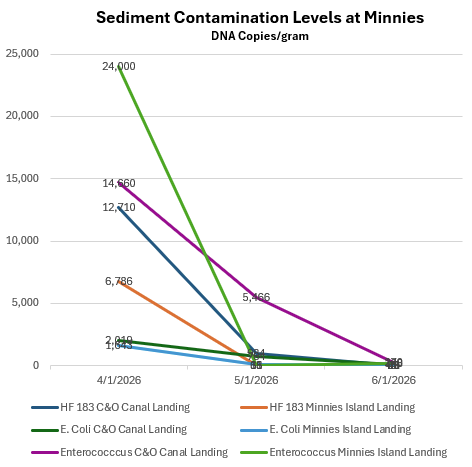
As there are no widely accepted human health standards for these four parameters, sediment testing remains a murky science. To better understand the results of MDE’s June 29 sediment test results, Minnies board members dug deeper into the parameters measured:
HF183 is a genetic marker in Bacteroides that lives in human guts and nowhere else. Geese, deer, dogs, and raccoons do not produce it. If HF183 is present, human sewage is present. It is the standard marker for microbial source tracking.
E. coli and Enterococcus are general fecal indicators. They show fecal material is present, not whose. In sediment they are also unreliable, because both can survive for months and can regrow in warm, organic-rich mud. A high Enterococcus number in sediment does not mean recent contamination.
Despite the lack of well-established standards in this area of testing, the key take-away from the June 29 readings was that a significant month-over-month reduction of the four parameters had occurred, and bacteria levels were similar in comparison to above-the-spill baselines at Old Anglers and Carderock. It was also assumed that additional reductions occurred between June 29 and July 29 when the results were released. MDE shared comparative sediment testing results for additional sites (Appendix F).
On July 31, the Montgomery County Department of Health lifted their previous advisory for all Potomac River shorelines and sediments (Appendix G).
After a closure of more than six months, Minnie’s Island was finally considered safe for public recreation.
Impacts of the Spill on MICC 2026 Programming
The spill caused MICC to suspend almost all our 2026 programming, including the following:
● Our island is generally open to public access during all daylight hour; however, we had to totally shut the island to all visitors from January 19 through July 31. Hundreds of visits that would have taken place did not occur.
● Our traditional June Isle Fest was held at the Cabin John Gardens Community Center rather than on the island. Attendance was significantly reduced
● Plans to host DC summer school students for day trips to the island were put on hold
● Major cabin reconstruction projects (eg. replacing the roof) postponed
● Hosting of Team River Runner volunteers and Wounded Warriors were put on hold
● Island tours for first time visitors were not held
● No volunteer workdays were held.
However, over 40 trees and shrubs funded by the Chesapeake Bay Trust were planted and watered by Joe Saliunas with volunteers Rob Bragan (board member emeritus) and Molly Carr, and Jack Mandel and Rob launched an extensive project of re-shingling the entire exterior of the cabin.
Impact of Minnie’s Advocacy and Lessons Learned
Before the spill on January 19th, Minnie’s biggest challenge was battling invasive weeds and figuring out how to transport a one-ton wood burning stove across the channel on canoes. Overnight we had to pivot from being weed-warriors, builders, and paddlers into activists, collaborators, and leaders. MICC takes pride in having spearheaded multiple correspondences to DC Water and MDE, crafting and commenting on sensitive communication from the CLEAR coalition, and investing multiple hundreds of hours into research, coordination, and field observation to support engagement.
Working in solidarity with our allies, we learned a lot along the way. MICC hopes to proactively share the following lessons with areas impacted by future significant sewage spills, wherever they may occur:
● Document impacts. Take photos, record videos, document observations. Use satellite images where available;
● Advocate for comprehensive environmental testing as soon as the spill occurs. It took DC Water 10 days to begin water testing, and it was 3 months before sediment testing was performed by MDE. Aquatic organism sampling never occurred;
● Alert the media ASAP. Provide documentation of impacts, and potential interview subjects. Initial media reports for the Cabin John spill focused on traffic impacts. It took the media several days to realize the magnitude and impact of the spill;
● Request a single point of contact from the organization responsible for the spill. MICC engaged with several different representatives from DC Water, and it was never clear who the appropriate point of contact was. DC Water should have provided a single point of contact for key stakeholders such as MICC;
● Support Riverkeepers. Potomac Riverkeeper Network performed an essential role in conducting testing and alerting the media;
● Form communities with stakeholders with shared interests. Early on, MICC coordinated with the Montgomery Sycamore Island Club and Canoe Cruisers Association since we had a shared interest in non-tidal impacts to the Potomac. MICC also joined the CLEAR Potomac Coalition, coordinated by The Potomac Conservancy. This mechanism allowed more effective and efficient communication with all stakeholders, including elected officials who could advocate for impacted communities;
● Advocate for national standards for sediment testing. While sediment testing eventually occurred, the lack of standards made understanding of the results challenging;
● Establish a baseline for E Coli and other indicators before a spill happens that can be used to assess impacts during a spill and to identify when conditions have returned to baseline conditions.
“Rivers are easily wounded . . . “

River otters frolicking on Minnie’s, July 2026
In the early fall days nine months following the spill, the river flows clear again around Minnie’s shoreline. No obvious impacts to Minnie’s land-based environment have been observed: the native saplings painstakingly planted and watered by MICC board members and volunteers throughout the drought are thriving. Dense fields of bearfoot blossoms play host to hungry swallowtail butterflies and goldfinches. Pawpaws and osage apples litter the ground in abundance.
But none of us have forgotten the nightmare of those first weeks of the spill and the shoreline choked with dead fish. It’s a reasonable assumption that all stationary aquatic life (macroinvertebrates, mollusks, etc.) were similarly impacted. However DC Water never conducted monitoring of benthic organisms – the creatures that live above, on, or below the river’s surface – so we’ll never fully know the lingering impact of the spill on these organisms.
But for now, the water teems with darting minnows and skittering waterbugs. Otters made a celebrity appearance, romping and snacking on fish for several days in the channel. Osprey, falcons, and mergansers tended to their young. We’ve had to sidestep a stray copperhead or two and the mosquitos are back in full force, but even those give reassurance that the spill’s impact, while horrific, was short-lived.

The Potomac Interceptor pipeline and its uncomfortable proximity to the river
In his book, Is a River Alive? Richard McFarlane writes, “Rivers are easily wounded… but given a chance, they can heal themselves again.” While healing of the Potomac seems evident, it would be easy and wrong for us to assume that the pipeline rupture was a one-time disaster. Our eyes have opened to the active threat of an aging infrastructure and its disturbing proximity to a long section of the Potomac. MICC remains active in the CLEAR alliance and continues to petition DC Water for transparency and MDE for solutions.
We’re back to being paddlers, naturalists, builders and educators. But we’re not letting go of our roles as advocates and leaders in protecting Minnie’s and the Potomac from future disasters. Our river has healed, but it may not heal a second time. That’s a gamble we refuse to take, and with the steadfast support we’ve come to expect from our Cabin John community, volunteers, and friends, we remain vigilant, vocal, and responsive.
Appendix A - January 24 letter from Joe Saliunas, MICC Board Chair to David Gadis, CEO of DC Water

Appendix B - February 7 email from Joe Saliunas, MICC Board Chair, to Barbara Mitchell,
DC Water Associate General Counsel for Government Affairs

Appendix C - Excerpt from February 24 letter from Canoe Cruisers Association, Sycamore Island Club, and MICC to DC Water, DC Department of Energy and Environment, and Maryland Department of the Environment requesting sediment testing

Appendix D - Sediment testing results from April 14 showing high levels at Minnies Island (the two high bars)

Appendix E - MOCO closure of shoreline around Minnie's Island on May 18

Appendix F - Comparative MDE Sediment Testing Results from April through June 2026

Appendix F - MoCo July 31 announcement lifting their previous advisory and fully opening the shoreline, including Minnie’s Island, for public access.


